
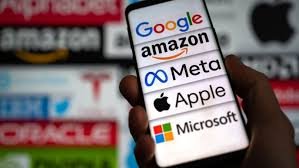
A handful of technology companies now wield more influence over global communication, commerce, finance, and geopolitics than most sovereign nations. Understanding how that power was built — and where it is taking us — is no longer optional for anyone who wants to navigate the world ahead.
In 1945, power was measured in aircraft carriers, nuclear warheads, and the size of a nation’s industrial base. In 1990, it was measured in GDP, trade relationships, and the reach of a country’s financial system. Today, power is increasingly measured in data centres, algorithm patents, satellite constellations, and the number of people who wake up every morning and reach for a device that runs your software before they have said a word to another human being.
Five companies — Apple, Microsoft, Google, Amazon, and Meta — have a combined market capitalisation that exceeds the GDP of every country on earth except the United States and China. They employ millions, but their influence extends to billions. They do not govern in the traditional sense. They do not field armies or collect taxes. But they control the infrastructure through which an increasingly large share of human communication, commerce, information, and finance flows. And infrastructure, historically, has always been a form of power — the kind that outlasts any election, any administration, and any treaty.
What is happening right now is not merely the rise of very large businesses. It is a structural shift in where power actually resides in the world — away from geography and toward platforms, away from governments and toward corporations, away from the visible exercise of force and toward the invisible architecture of code. The implications are profound, barely understood, and moving faster than the institutions built to manage them.
$12T+
Combined market cap of the top 5 US tech companies
5 billion
People use Google, Meta, or Apple products daily
60%
Of global internet traffic runs through Amazon Web Services
01
From Garage Startups to Sovereign-Scale Entities
The speed of this transformation is historically without precedent. Apple was incorporated in 1976 in a garage in Los Altos. Google was founded in a Menlo Park garage in 1998. Meta launched from a Harvard dorm room in 2004. These are not ancient institutions that accumulated power over centuries of conquest and diplomacy. They are companies younger than many of the people reading this, that grew from nothing to world-altering scale within a single human lifetime — in some cases, within a single decade.
What enabled that growth was not simply clever engineering. It was a set of economic dynamics that the existing regulatory and competitive framework was completely unprepared for. Network effects — where a platform becomes more valuable to each user as more users join — created winner-take-all markets in which the leading platform accumulated advantages so durable that competition became structurally impossible. Data flywheels — where more users generate more data, which enables better products, which attract more users — created self-reinforcing advantages that compounded over time. And the near-zero marginal cost of digital distribution meant that a product built once could be deployed to a billion people for essentially nothing.
The result was concentration on a scale that the architects of antitrust law in the early 20th century could not have imagined. Standard Oil, the canonical example of monopoly power that shaped American antitrust legislation, controlled about 91 percent of US oil refining at its peak. Google controls roughly 92 percent of the global search market. Meta controls the social graph — the map of human relationships online — in a way that has no historical analogue and that no competitor has meaningfully challenged in over a decade.
“Standard Oil controlled 91% of US oil refining at its peak. Google controls 92% of the global search market — and the tools we built to stop Standard Oil were never designed for this.”
02
Data Is the New Oil — and They Own the Refineries
The phrase “data is the new oil” has become a cliché. Like most clichés, it contains a real insight that repetition has drained of its original force. The insight is this: in an information economy, the entity that controls the most comprehensive and highest-quality data about human behaviour has an advantage over every other entity — commercial, governmental, or geopolitical — that is difficult to overstate and nearly impossible to replicate.
Google knows what you are curious about, anxious about, researching, planning, and afraid of — in many cases, before you have told anyone. Meta knows who your friends are, what your relationship status is, what content makes you angry, what content makes you happy, and which of those emotional states makes you more likely to click on an advertisement. Amazon knows what you buy, what you consider and reject, what your household consumes, and how price-sensitive you are across thousands of product categories. Apple knows where you go, who you call, what you listen to, and — increasingly — what your body is doing while you do all of it.
This data is not merely a commercial asset used to sell advertising. It is the raw material for AI systems that are already reshaping hiring decisions, credit scoring, content moderation, political discourse, and national security intelligence. The country or company that has the most comprehensive data on the most people, processed through the most capable AI systems, has a strategic intelligence advantage that no Cold War-era surveillance apparatus could have matched. This is not speculation. It is the explicit strategic logic of the US-China technology competition that is now the defining axis of 21st-century geopolitics.
03
The US-China Tech War: A New Kind of Cold War
The competition between American and Chinese technology ecosystems is the most consequential geopolitical contest of our time — more structurally significant than any territorial dispute, any trade negotiation, or any military posturing, because it is a competition over the infrastructure of the global economy for the next century. Whoever dominates the platforms through which the world communicates, transacts, and computes will exercise a form of structural power that no military victory could deliver.
China has responded to Western tech dominance with a strategy that is coherent, patient, and enormously well-funded. The Great Firewall keeps American platforms out of the Chinese market, protecting domestic champions — Baidu, Alibaba, Tencent, ByteDance — from competition while they develop the scale and capability to compete globally. Chinese companies are investing aggressively in AI, semiconductors, satellite infrastructure, and undersea cables — the physical layer of the internet — in ways that are explicitly strategic rather than merely commercial. The Belt and Road Initiative, often discussed as an infrastructure programme, is simultaneously a digital strategy: Chinese-built telecom networks in dozens of countries mean Chinese-controlled data flows and Chinese-built surveillance capabilities embedded in the infrastructure of nations that may not fully understand what they have accepted.
The battleground that most clearly illustrates the stakes is semiconductors. The most advanced chips in the world — the silicon that powers AI, cloud computing, and modern military systems — are designed primarily by American companies (Nvidia, Qualcomm, Apple) and manufactured almost exclusively in Taiwan, by TSMC. This concentration of critical technology in a geopolitically contested island is one of the most significant strategic vulnerabilities in the global economy. American export controls on advanced semiconductor technology to China, introduced and tightened significantly between 2022 and 2025, represent the most dramatic use of technology as a geopolitical weapon since the COCOM restrictions of the Cold War.
“Control the chip, and you control the AI. Control the AI, and you control the surveillance. Control the surveillance, and you control — or can influence — the government. This is the logic that is driving the most consequential technology competition in human history.”
— Ian Bremmer, Eurasia Group, 2024
04
When Platforms Become Governments
In January 2021, Twitter and Facebook suspended the sitting President of the United States. Whatever your political assessment of that decision, its significance as a demonstration of power was unmistakable: two private companies, accountable to no electorate and subject to no democratic process, exercised the ability to silence the most powerful political figure in the world. The decision was debated primarily as a question of free speech. It should also have been debated as a question of sovereignty — of who, in a democratic society, holds the authority to determine what can and cannot be said in the public square.
Tech platforms now exercise powers that were once the exclusive domain of governments: they determine what information reaches whom, they adjudicate disputes between parties operating on their platforms, they set the rules of conduct for billions of people, and they can exclude individuals or organisations from participation in the digital public sphere. Meta’s content moderation decisions have more practical impact on global political discourse than the editorial policies of any newspaper, any broadcaster, or any government communications agency. YouTube’s recommendations algorithm shapes what hundreds of millions of people understand about history, science, medicine, and politics — not through any editorial process or democratic accountability, but through an optimisation function designed to maximise watch time.
Elon Musk’s acquisition of Twitter — renamed X — added a further dimension to this conversation. A single individual, through a leveraged buyout financed partly by loans against his Tesla shares, acquired one of the world’s most important political communication platforms and immediately restructured its moderation policies, reinstated previously banned accounts, and used it as a vehicle for his own political views and commercial interests. The transaction raised questions that existing legal frameworks were not designed to answer: what happens when critical public infrastructure is owned by someone who does not separate their personal agenda from the platform’s operation?
“Two private companies, accountable to no electorate, exercised the power to silence the sitting President of the United States. That is not a content moderation story. It is a sovereignty story.”
05
Big Tech and the Future of Money
The most consequential frontier in the expansion of big tech’s power is finance. For most of the digital era, technology companies were content to sit adjacent to money — to enable transactions, to provide payment infrastructure, to connect buyers and sellers — while the actual business of money remained with regulated banks and financial institutions. That era is ending.
Apple Pay, Google Pay, and Amazon Pay have already captured significant shares of digital payment volume. Apple’s savings account product, launched in partnership with Goldman Sachs in 2023, attracted $10 billion in deposits within four days — a faster accumulation of deposits than any bank launch in history. Meta’s abandoned Libra/Diem stablecoin project was killed by regulatory intervention, but it demonstrated clearly that a company with three billion users could, in principle, create a monetary system that operated outside the jurisdiction of any central bank. The regulatory response — swift, international, and unusually coordinated — showed that governments understood the stakes.
The tension between big tech’s financial ambitions and the existing monetary order is one of the defining dynamics of the next decade. On one side: technology companies with unprecedented reach, data advantages, and user trust, pushing into financial services that incumbents have chronically underdelivered. On the other: central banks, regulators, and legacy financial institutions fighting to maintain the boundaries that keep tech companies out of the money supply itself. The outcome of that contest will determine whether the next generation of monetary infrastructure is controlled by governments, by legacy banks, by technology platforms, or by decentralised protocols that answer to none of them.
06
The Global South: Leapfrogging, Dependency, and the Third Option
The impact of big tech’s power expansion is felt most acutely — and most unequally — outside the Western world. For billions of people across Africa, Asia, and Latin America, access to the internet is effectively synonymous with access to Facebook. Meta’s Free Basics programme, which provided zero-rated access to a curated set of websites in dozens of countries, gave hundreds of millions of people their first experience of “the internet” — an experience that was, in fact, a walled garden controlled by a single American corporation. The programme was eventually banned in India, which understood what it represented, but continues elsewhere.
In financial services, the picture is more complex and more hopeful. Africa in particular has become the most dynamic laboratory for mobile financial services in the world — not because big tech led the way, but because the gap left by legacy banking created space for homegrown innovation. M-Pesa in Kenya, Flutterwave and Paystack across West Africa, MoMo across multiple markets: these are not American tech giant products. They are built by Africans, for African realities, on the insight that a continent of underbanked populations with high mobile penetration represents one of the most significant financial service opportunities in the world.
Bitcoin and stablecoins represent a third option for the Global South — one that is neither dependent on Western tech platforms nor subject to the monetary instability that characterises many local currencies. In Nigeria, Ghana, Kenya, and across the continent, cryptocurrency adoption rates consistently rank among the highest in the world — not driven by speculation, but by the very practical need for a store of value and a means of exchange that cannot be devalued overnight by a central bank decision. The monetary problems that drive Bitcoin adoption in the developing world are, in miniature, the same problems that fiat money creates everywhere. They are simply more visible, and more urgent, where the institutional buffers are thinner.
07
What Comes Next — and What It Means for You
The trajectory of big tech power is not fixed. The regulatory response is accelerating — the EU’s Digital Markets Act, the US antitrust actions against Google and Apple, India’s assertive digital sovereignty policies, and the growing willingness of governments worldwide to treat tech platforms as systemically important infrastructure rather than as ordinary businesses. Whether this regulation proves effective is uncertain. What is clear is that the era of big tech’s uncontested expansion is over. The question now is what kind of constrained expansion comes next.
Artificial intelligence is the next major dimension of this contest. The companies that control the most capable AI systems will exercise a form of cognitive leverage — the ability to analyse, decide, and act faster and at greater scale than any competitor — that compounds every other advantage they already hold. The race to build and deploy frontier AI is not merely a product competition. It is a power competition, and the stakes are sovereign. The outcome will determine whether AI capability remains concentrated in the hands of a small number of American and Chinese corporations, or whether the infrastructure of intelligence is made broadly accessible — through open-source models, through decentralised compute networks, through the kind of deliberate policy choices that determined whether the internet became a public commons or a private fiefdom.
For individuals — for the people reading this, building their financial futures, making decisions about where to save, invest, and transact — the restructuring of global power by big tech has direct practical consequences. The platforms you use are not neutral utilities. They are entities with interests, with political alignments, with business models that may or may not be aligned with yours. The financial infrastructure you depend on is being rebuilt — by governments, by tech companies, by decentralised protocols — and the outcome of that rebuilding will determine how much financial autonomy you actually have in the decade ahead. Staying informed about who controls the systems you depend on is not paranoia. It is the minimum requirement for financial literacy in the 21st century.
The five companies that reshaped the world’s information architecture did so in thirty years. The five that will reshape the world’s financial architecture may do so in ten. The question is whether that architecture will be built to serve the people who use it — or whether it will be built, as most power structures are, to serve those who control it. Decentralised money, open protocols, and the right of individuals to transact without permission are not ideological positions. They are the practical response to a power dynamic that, left unchecked, will define the terms of economic participation for the next generation.
Now Available:
Fiat, Bitcoin, Stablecoins,
and the Future of Money
Who controls the money controls the world. Understand the monetary revolution — and how to position yourself for what comes next. By Success Austin.
Get the Book →